QIAS Courses In Cairo : From Alphabet to Eloquence
QIAS Courses In Cairo : From Alphabet to Eloquence
Master Arabic and the Qur’an : Face-to-Face Immersion
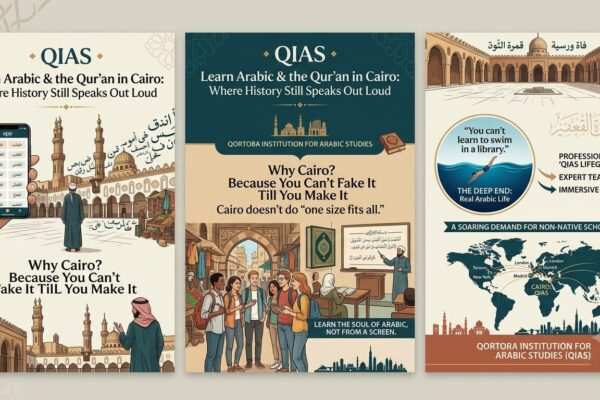
Doubtless, there is no royal road to mastery, and nowhere is this truer than in the acquisition of Arabic and the sciences of the Qur’an. For non-native speakers, particularly children and adults from Spain and Germany, and increasingly from the United States, Canada, France, and Britain, QIAS (Qortoba Institution for Arabic Studies) in Cairo offers what screens cannot: a living tradition, taught face to face, where every syllable is weighed and every meaning earned. As the Arabic proverb states, “العلم في الصغر كالنقش على الحجر” — “Knowledge in youth is like engraving on stone.” We extend that permanence to learners of all ages.
- Why QIAS In Cairo, & Why Vis_A_Vis ?
To study Arabic in Cairo is to drink from the source. The city remains the beating heart of the Arabic alphabet and Islamic scholarship, home to Al-Azhar, the world’s oldest continuous seat of learning. For a student in Madrid or Berlin, the difference between online drills and a Cairo classroom is the difference between reading about fire and feeling its warmth. Direct instruction allows for immediate correction of the emphatic sounds that distinguish ṣād from sīn, and ḍād from dāl: the very soul of eloquence. Here, knowledge is not downloaded; it is transmitted, as the scholars say, “بالتَّلقِّي والمُشافَهة”, “by direct reception and oral instruction.”
- QIAS Course Architecture: From Alphabet to Eloquence
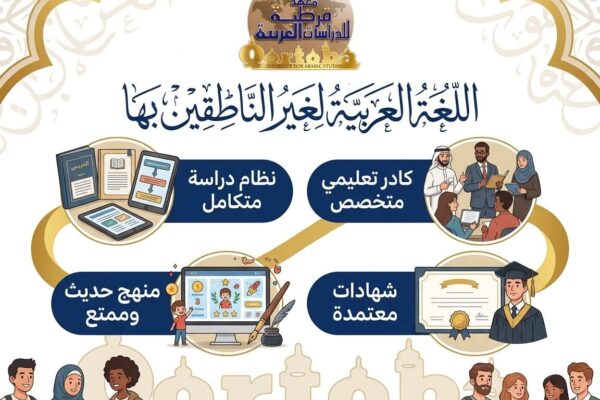
QIAS stratifies its curriculum so that every non-native speaker learner across the globe such as Spain, Germany, America, Canada, France, and Britain, child or adult, enters at the right threshold and exits with measurable mastery:
- QIAS Classical Arabic & Qur’anic Foundation: Systematic study of nahw (grammar) and sarf (morphology) anchored in Qur’anic lexis. Students learn to parse a verse before they memorize it, fulfilling the maxim “الفهم قبل الحفظ”, “Comprehension before memorization.”
- QIAS Modern Standard Arabic (MSA) Intensive: Designed for professionals and university students from Britain, Canada, and the United States. Emphasis on media, formal correspondence, and academic writing, moving learners from “getting by” to “holding forth.”
- QIAS Tajwīd and Hifz Programs: Recitation and memorization under Azhar-certified shuyūkh. Children’s tracks use incremental methods and reward systems; adult tracks pair memorization with tafsīr to ensure the tongue and the mind advance together.
- QIAS Conversation Courses: QIAS Flagship: These are not phrasebook drills. Through role-plays, debate circles, and market simulations, students acquire the art of spontaneous expression. The goal is to move from “أفهم ولكن لا أستطيع أن أتكلم”, “I understand but I can’t speak,” to “أعبر عن نفسي بطلاقة”, “I express myself fluently.” Cohorts are capped at eight to guarantee airtime, and weekly phonetic labs target the specific interference patterns of Spanish, German, English, and French speakers. The class employs QIAS videos professionally tailored for non-native speaker students with clear pronunciation and accurate articulation by seasoned professors of the Arabic language , as the link below shows:
https://www.youtube.com/watch?v=4ucNoCYbTds
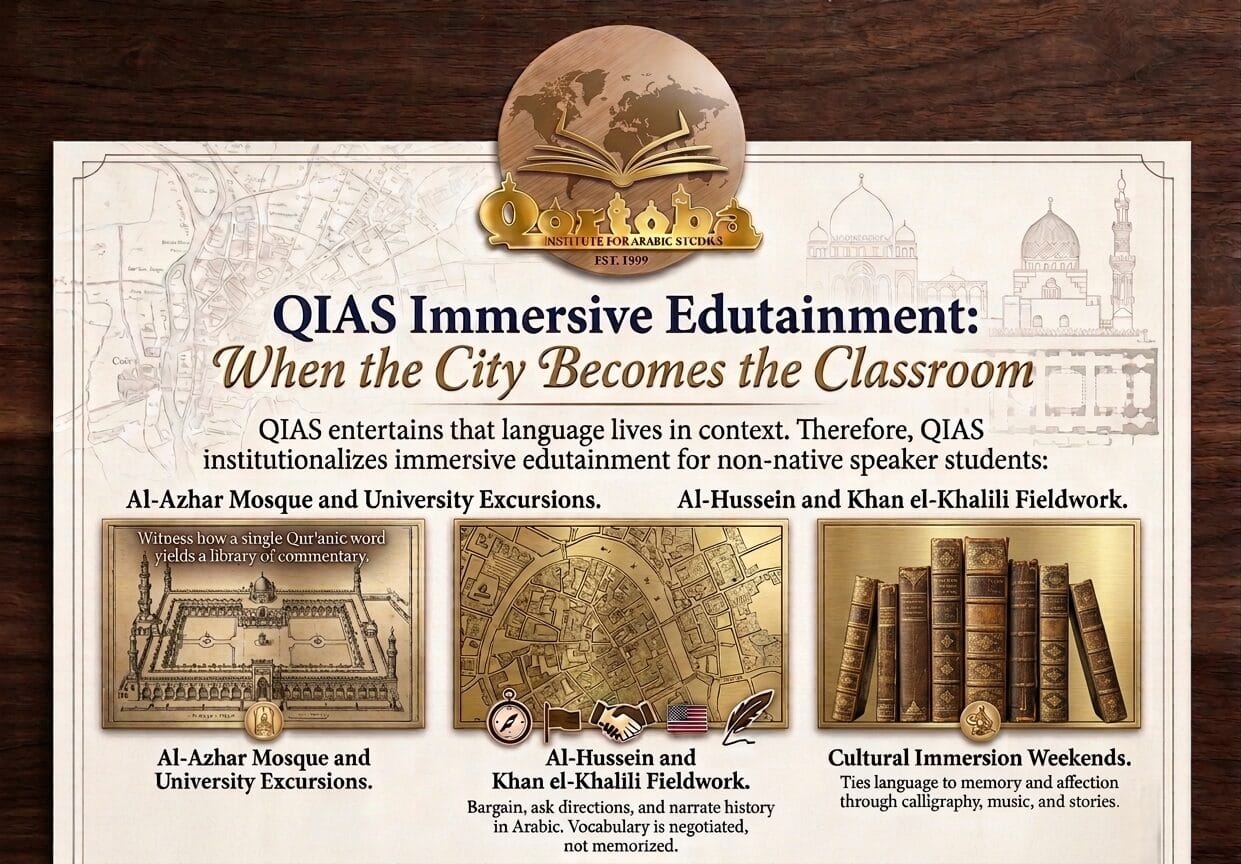
- QIAS Immersive Edutainment: When the City Becomes the Classroom
QIAS entertains that language lives in context. Therefore, QIAS institutionalizes immersive edutainment for non-native speaker students:
- Al-Azhar Mosque and University Excursions: Students visit halaqāt and witness how a single Qur’anic word can yield a library of commentary. It is here that the phrase “مجلس العلم روضة من رياض الجنة”, “The gathering of knowledge is a garden from the gardens of Paradise,” becomes tangible.
- Al-Hussein and Khan el-Khalili Fieldwork: Guided linguistic trips where non-native speaker learners worldwide such as Spain, Germany, America, Canada, France, and Britain must bargain, ask directions, and narrate history in Arabic. The vocabulary of commerce, greeting, and courtesy is not memorized; it is negotiated.
- Cultural Immersion Weekends: Arabic calligraphy, maqāmāt music appreciation, and storytelling nights. For a child from France or an adult from America, these weekends tie language to memory and memory to affection.
- QIAS Pedagogy for the Non-Native Mind
QIAS includes bilingual coordinators fluent in English, Spanish, German, and French. They bridge the first thousand yards, after which Arabic itself becomes the medium of instruction. Assessment is oral and performance-based. We do not ask, “Can you conjugate?” We ask, “Can you convince, console, or conduct business?” As the English idiom goes, the proof of the pudding is in the eating.
- Common Phrases in QIAS Courses
Below is a representative selection of expressions every student internalizes, from survival Arabic to Qur’anic register:
English | Arabic | Context Used |
Peace be upon you | السلام عليكم | Universal greeting, classroom and street |
How are you? | كيف حالك؟ | Conversation Course, Level 1 |
With pleasure | بكل سرور | Polite affirmative in dialogue practice |
Could you repeat that, slowly? | ممكن تعيد ذلك، ببطء من فضلك؟ | Phonetic lab and fieldwork |
How much is this? | بكم هذا؟ | Khan el-Khalili market simulation |
I am from Spain / Germany | أنا من إسبانيا / ألمانيا | Self-introduction module |
| I seek refuge in Allah from Satan, the rejected | أعوذ بالله من الشيطان الرجيم | Tajwīd & Qur’an class opening |
In the name of Allah, Most Gracious, Most Merciful | بسم الله الرحمن الرحيم | Daily class and recitation start |
May Allah reward you with good | جزاك الله خيرًا | Expression of gratitude, all levels |
| Practice makes perfect | التكرار يعلم الشطار | Idiom used by instructors: repetition teaches the skilled |
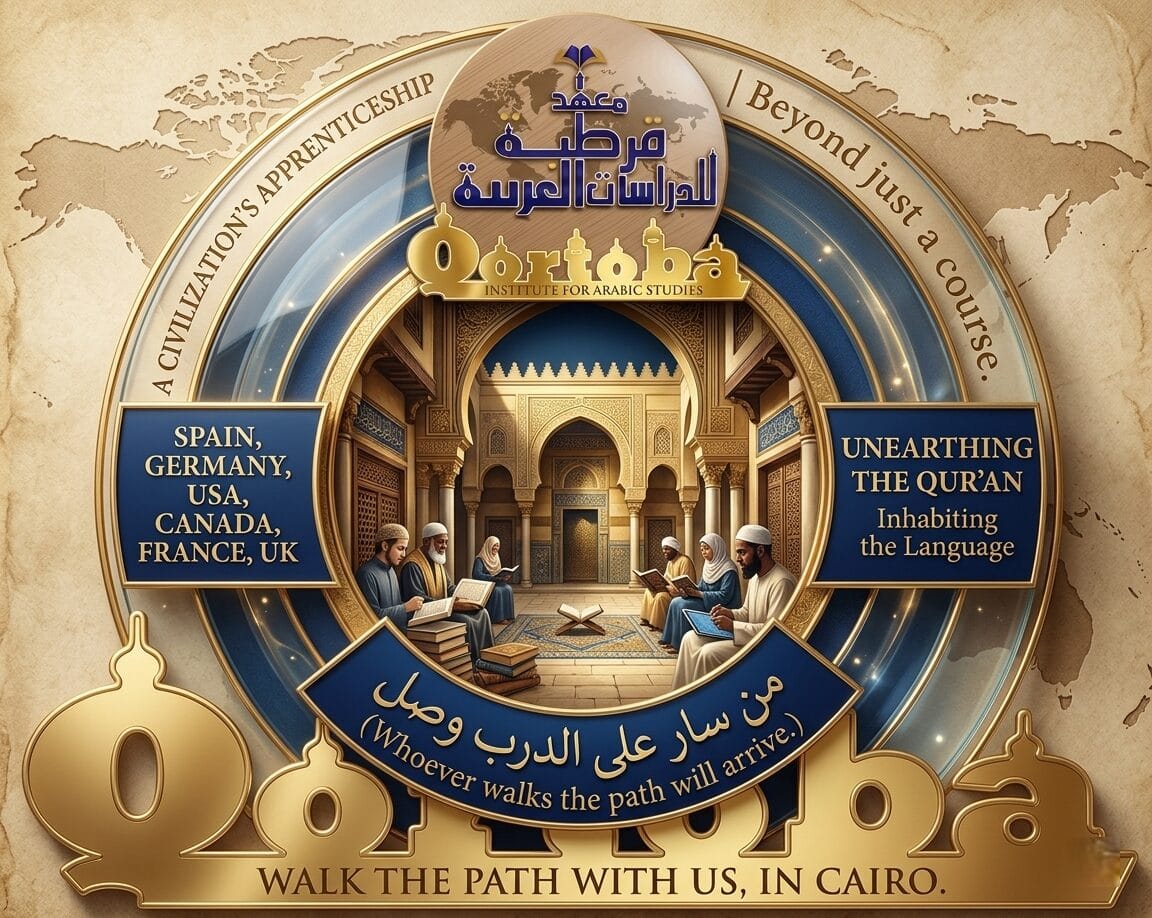
In a nut shell, for non-native speakers in Spain and Germany, and for learners across the United States, Canada, France, and Britain, QIAS (Qortoba Institution for Arabic Studies) offers more than a course. It offers an apprenticeship in a civilization. Non-native speaker scholars do not merely study Arabic; they inhabit it, in the shadow of Al-Azhar and in the alleys of Al-Hussein, until the language is no longer foreign and the Qur’an is no longer distant. As the proverb says, “من سار على الدرب وصل”, “Whoever walks the path will arrive.” Thus, QIAS invites you to walk it with us, in Cairo.
Tag:arabic, Arabic alphabet, Arabic Grammar, Arabic language, Arabic languages . Arabic languages . arabic alphabet . arabic alphabet in english . arabic curriculum for kids ., Arabic languages . Arabic languages . arabic alphabet . arabic alphabet in english . arabic curriculum for kids . muslim learn arabic, Quran, The importance of learning languages, Uncategorized Arabic alphabet, world Arabic language day, world Arabic language day . française