Embrace Summer Edutainment at QIAS Cairo: Where the Tongue Learns and the Heart Understands
Embrace Summer Edutainment at QIAS Cairo: Where the Tongue Learns and the Heart Understands
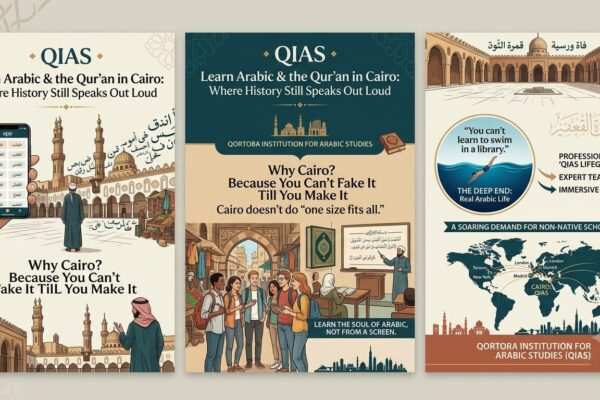
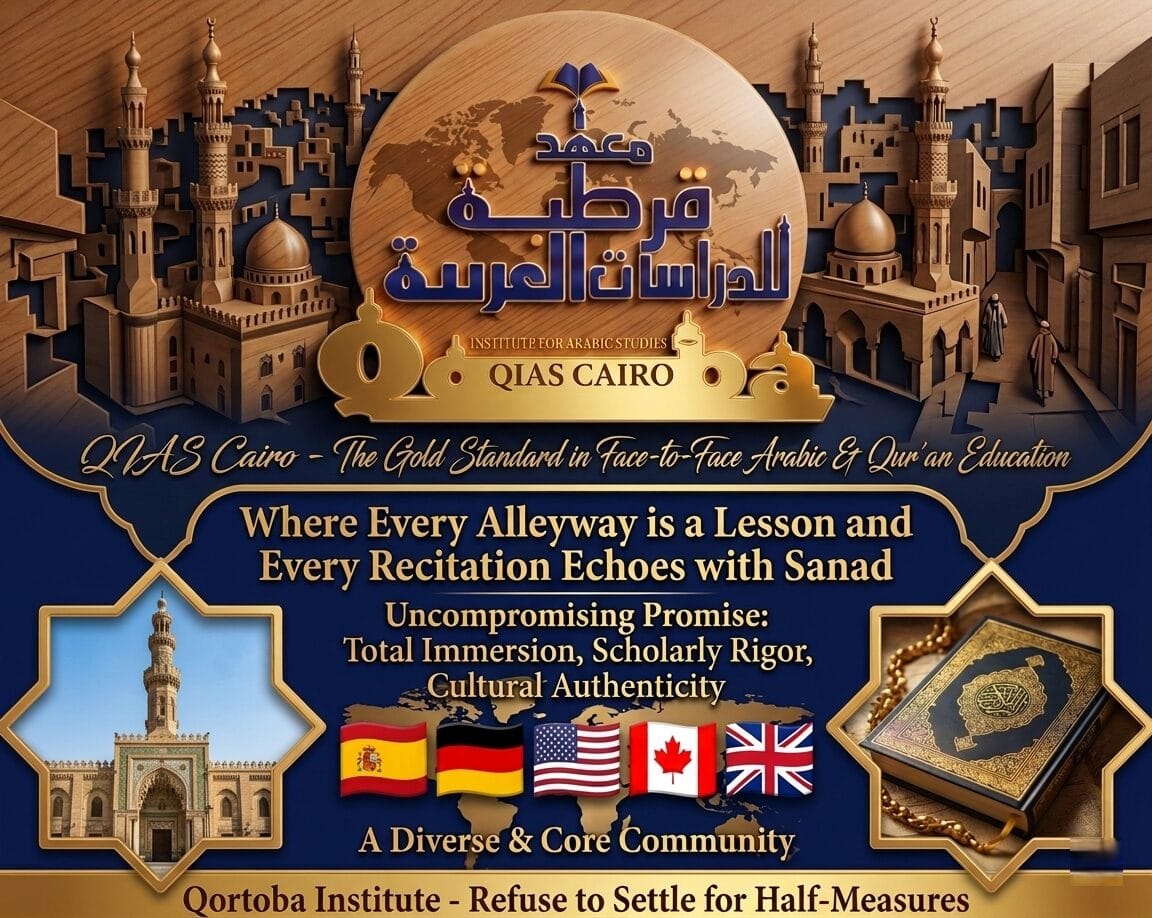
Definitely, for the non-native speaker who refuses to settle for half-measures, QIAS (Qortoba Institution for Arabic Studies) in Cairo is the gold standard in face-to-face Arabic and Qur’an education. Situated minutes from Al-Azhar and the living heritage of Islamic Cairo, QIAS invites non-native speaker students from Spain and Germany as our core community, with dedicated cohorts from the United States, Canada, France, and Britain. QIAS promise is uncompromising: total immersion, scholarly rigor, and cultural authenticity, delivered in a milieu where every alleyway is a lesson and every recitation echoes with Sanad.
- Immersive Education: From Classroom to Cairo
At QIAS, the city is the syllabus. Non-native speaker students do not merely study Arabic. They live it from the moment they step out the door. Non-native speaker learners all over the world such as Spain, Germany, America, Canada, France, and Britain will order Ful and Ta‘miyya in ‘Ammiyya before morning class, debate a news article in Modern Standard Arabic by noon, and review Sifaat Al-Huruf with an Azhari sheikh after Asr (after noon). QIAS calls it learning by doing, because when the stakes are real, the language sticks. As, QIAS provides the path, you take the steps.
- QIAS Face-To-Face Courses: Structured Pathways, Flexible Entry
Every scholar is different, so QIAS tracks are bespoke yet rigorous:
Non-Native Speaker Children’s Arabic & Qur’an Classes : Ages 4–14 Qaida Nooraniyah with phonetic color-coding and AR letter tracing. Hifz with gamified revision: students earn badges for every Juz’ mastered.
- Edutainment: Arabic puppet theatre, calligraphy workshops, and Qur’anic story animation.
- Outcome: Read, write, and recite with basic Tajweed.
- Non-Native Speaker Adult Intensive Modern Standard Arabic ( Levels A1–C1 CEFR ) :
- Learning Weekly Plan: Grammar, Muhadatha (conversation), media Arabic, dictation & weekly Majlis with native speakers from Al-Azhar University.
- Project : By level B2, students present a 10-minute talk on a Vision 2030 topic in fus’ha.
- Non-Native Speaker Classical Arabic & Qur’an with Ijazah Track :
- One-To-One Talaqqi and practice: with scholars holding Ijazah in Hafs ‘an ‘Asim.
- Tajweed Sessions : with spectrogram feedback to visualize ghunnah and qalqalah.
- Tafseer & ‘Ulum al-Qur’an: seminars by seasoned professionals from Al-Azhar.
- Non-Native Speaker Egyptian Arabic Conversation, Survival to Fluency Scenario training: Navigating Khan El-Khalili, doctor visits, football debates. QIAS presents videos professionally designed for non-native speaker students with clear pronunciation and accurate articulation by top notch professors of the Arabic language , as the link below shows:


https://www.youtube.com/watch?v=Bl-B8GSv4To
- Linguistic Fieldwork: recorded interviews with artisans in Al-Hussein, transcribed and analyzed in class.
- Common Arabic Colloquialisms
These phrases are used daily across various dialects, though some are region-specific. Colloquial phrases bridge the gap between formal language and the way people actually speak. While standard Arabic (MSA) is used in news and books, dialects like Egyptian or Levantine are what you will hear on the street. English also relies heavily on idioms and filler words that can be confusing if taken literally.
| يعني – yaani |
| Meaning: like / it’s like / I mean Dialect: All Arabic dialects Usage: Filler word in conversation (like “um” or “you know”) |
| هلا والله – hala wallah |
| Meaning: Hi there! / Welcome! / My pleasure Dialect: Gulf Usage: Greeting someone warmly or responding to a thank-you. |
| أكيد – akeed |
| Meaning: Sure! / Of course! Dialect: All Arabic dialects Usage: Emphatic confirmation. |
| شكو ماكو – shaku maku |
| Meaning: What’s up? / What’s new? Dialect: Iraqi Usage: Casual greeting to check in on someone. |
| ولو – walaw |
| Meaning: Don’t mention it / of course / it’s okay Dialect: Levant (especially Lebanon) Usage: Used to make someone feel welcome or brush off thanks. |
| يا حرام – ya haram |
| Meaning: Aww, poor thing Dialect: Levant Usage: To express sympathy, either sincerely or sarcastically. |
| فهمت علي شلون؟ – fahamit alyee shlon? |
| Meaning: Do you get what I mean? Dialect: Levant (esp. Syrian) Usage: Rhetorical check for understanding after explaining something. |
| حبيبي / حبيبتي – habibi / habibti |
| Meaning: My dear / sweetheart / darling Dialect: All Arabic dialects Usage: “Habibi” is used for males and “habibti” for females, often affectionately among friends, family, or partners. |
| · Ala Rasi (على راسي): Literally “On my head,” used to mean “With pleasure” or “Anything for you”. |
- Non-Native Speaker Family & Summer Edutainment Immersion Packages :
Parallel tracks for parents and children, plus joint cultural excursions. Homestay options are available with vetted Egyptian families for 24/7 language exposure.
- QIAS Up-To- Date Teaching Technology: The Right Tool for the Right Function
QIAS harnesses technology to sharpen the human element, not replace it:
- Smart Classrooms: Interactive whiteboards for live parsing of Qur’anic verses and sentence diagramming.
- Pronunciation Videos : Speech-recognition videos and training on Makharij to give professional learning on
ض vs. د and ق vs. ك.
- VR & Video Heritage Modules: Walk through the Mosque of Ibn Tulun or the Citadel before you visits, learning vocabulary in context.
- Student LMS Portal: Tracks Hifz with spaced-repetition algorithms, records Tilawah for teacher commentary, and hosts peer Mushafahah sessions for students in Berlin or Madrid to practice with Cairo classmates.
- Digital Sanad Ledger: Each completed text and Ijazah is recorded with teacher chain of transmission, giving you a credential you can take anywhere.
- QIAS Outdoor Learning and Edutainment: Where Memory Meets Meaning
Knowledge sticks when it is felt. QIAS calendar is built around Cairo’s intellectual and spiritual landmarks:
- Al-Azhar Immersion Days: Students sit in the Riwaq of Al-Azhar, attend Halaqas on Ajrumiyyah and Nahw, and meet scholars. The goal is to see that ‘ilm is a living chain, not a PDF.
- Al-Hussein & Khan El-Khalili Field Projects: Learners conduct ethnographic interviews, map the bazaar in Arabic, and present findings. You learn the word for copper while buying a finjan.
- Nile & Desert Edutainment: Weekend retreats to Fayoum and Wadi El-Rayan combine Arabic-only team challenges, astronomy nights with Arabic star names, and Tadabbur sessions at sunset.
- Qur’an Memorization competitions: Monthly competitions judged on Hifz & Tajweed. Winners receive Ijazah in shorter surahs.
- QIAS Arabic Theatre & Media Lab: Students script, film, and subtitle short films in fus’ha. Next semester’s production, is going to be “في شوارع القاهرة”. It is going to be written and acted entirely by A2-level students. QIAS expects effort, and provides the structure to make it count. “Language is the road map of a culture. It tells you where its people come from and where they are going.” — Rita Mae Brown. QIAS Non-native speaker across the globe such as Spain, Germany, America, Canada, France, and Britain do not just decode Grammar. They read a civilization.
Hence, QIAS dedicated children’s division, where love for Arabic is set early and deep. For non-native speakers students in Spain, Germany, and Beyond, for families in Barcelona, Munich, London, Toronto, New York, and Paris, QIAS removes the barriers. It provides weekend cultural mediation. Female students learn with female Azhari instructors in dedicated facilities. Health, safety, and dietary needs are managed so parents sleep easily while their children thrive.
In a nut shell, non-native speaker scholars across the Earth such as Spain, Germany, America, Canada, France, and Britain come to learn Arabic &the Qur’an. They will leave with a second home. As, it is said in Egypt: “Makanak fi al-qalb”(مكانك فى القلب) , your place is in the heart. Enroll at QIAS (Qortoba Institution for Arabic Studies) in Cairo. The door is open. Cairo is calling. The only question is: are you ready to answer?
Tag:arabic, Arabic alphabet, Arabic Grammar, Arabic language, Arabic languages . Arabic languages . arabic alphabet . arabic alphabet in english . arabic curriculum for kids ., Arabic languages . Arabic languages . arabic alphabet . arabic alphabet in english . arabic curriculum for kids . muslim learn arabic, Quran, The importance of learning languages, Uncategorized Arabic alphabet, world Arabic language day, world Arabic language day . française