For many non-native Arabic speakers, studying Arabic is not simply about memorizing vocabulary or learning grammar. The real goal is to understand the language, speak it with confidence, and use it naturally in everyday life.
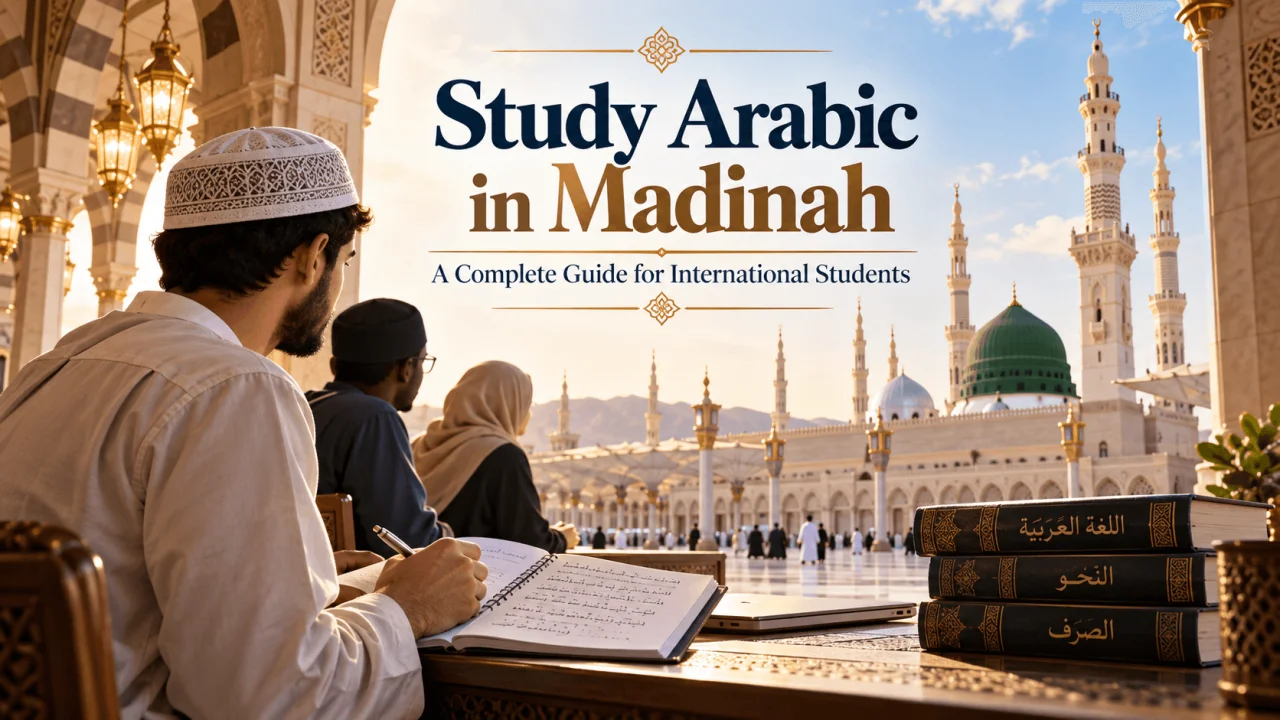
One of the most powerful ways to achieve this is to study Arabic in Madinah, where students can combine structured classroom learning with daily exposure to Arabic in a real Arabic-speaking environment.
Al-Madinah Al-Munawwarah also holds a unique place in the hearts of Muslims around the world. For students who want to improve their Arabic while strengthening their connection with the Quran and Islamic culture, studying in Madinah can offer an experience that is difficult to reproduce through online study alone.
This guide explains what international students should know before choosing an Arabic program in Madinah, what they can expect from an intensive course, and how to make the most of a short-term Arabic immersion experience.
Why Study Arabic in Madinah?
Learning Arabic inside an Arabic-speaking country gives students something that textbooks cannot fully provide: constant exposure to the language.
When you study Arabic in Madinah, Arabic is not limited to the classroom. You hear it in shops, restaurants, transportation, mosques, universities, and everyday conversations.
This gives learners repeated opportunities to recognize vocabulary and expressions they have studied during lessons.
For example, a student may learn how to ask for directions in class and then hear similar expressions while moving around the city later that day. This connection between structured study and real-life use can make new vocabulary easier to remember.
Madinah also provides a particularly meaningful environment for students interested in Quranic and Islamic Arabic. Learners frequently encounter Arabic connected with prayer, Quran recitation, Islamic terminology, and daily Muslim life.
Is Madinah Suitable for Beginner Arabic Students?
You do not need to be an advanced Arabic speaker before studying in Madinah.
A properly structured Arabic program should place students according to their current ability rather than expecting everyone to begin at the same level.
Qortoba Institute's Al-Madinah Arabic Program, for example, accepts learners from beginner through advanced levels. There are no Arabic-language prerequisites, and students take a placement assessment to determine the appropriate level before classes begin.
This means a beginner can focus on foundations such as reading, basic vocabulary, sentence construction, listening, and everyday communication, while more experienced learners can work on more advanced speaking, comprehension, grammar, and vocabulary.
Classroom Study and Arabic Immersion
Immersion works best when it is combined with structured teaching.
Simply living in an Arabic-speaking city does not automatically make someone fluent. Students still need teachers, a curriculum, correction, regular practice, and clear learning objectives.
A strong intensive program therefore combines two elements:
Structured study gives students the grammar, vocabulary, reading skills, and guidance they need.
Real-life exposure gives them opportunities to hear and use what they have learned outside the classroom.
Together, these can help learners move beyond passive knowledge and begin using Arabic more confidently.
Why Speaking and Listening Matter
Many Arabic students can read texts or complete grammar exercises but still find real conversations difficult.
This is often because spoken communication requires several skills to work together at the same time. A learner has to understand what another person says, recall vocabulary quickly, form a sentence, pronounce it clearly, and respond naturally.
For that reason, conversation and listening should form a major part of an immersion program.
In Qortoba's winter program in Madinah, more than 40% of the classes are concentrated on improving conversational and listening skills. Students work with practical topics such as introducing themselves, discussing family and daily routines, describing places, speaking about travel, jobs, friendships, and other everyday subjects.
Studying Arabic and Quran Together
For many international Muslim students, Arabic and Quran study are closely connected.
Improving Arabic can help students recognize Quranic vocabulary, understand grammatical structures, and develop a stronger relationship with the language of the Quran.
At the same time, Quran study provides regular exposure to correct Arabic pronunciation and recitation.
Qortoba's Al-Madinah program combines both areas. The current four-week program includes three hours of Arabic study and one hour dedicated to Quran recitation and memorization each study day. Classes run five days per week.
This allows students to spend most of their academic time developing Arabic while maintaining daily Quran study as part of the same program.
How Intensive Should an Arabic Course Be?
Short-term study abroad programs work best when students have enough classroom time to make meaningful progress.
Studying only a few hours per week may be suitable for long-term learners, but international students travelling specifically to study Arabic often benefit from a more concentrated schedule.
The current Qortoba Al-Madinah Arabic Program runs for four weeks and includes 80 study hours. Classes take place from Sunday to Thursday for four hours each day.
Students are expected to complete approximately two levels of Qortoba's 16-level Arabic system during the program, depending on their placement and progress. The Arabic curriculum is structured around Al-Arabiyyah Bayna Yadayk.
The intensive format is particularly useful for students who may not be able to spend several months abroad.
What Can You Learn in Four Weeks?
Four weeks will not make every learner fluent, and students should be cautious of programs promising instant mastery.
However, an intensive month can provide significant progress when classroom study, practice, and immersion are combined.
Depending on their starting level, students may improve their ability to:
- understand common spoken Arabic;
- participate in everyday conversations;
- increase practical vocabulary;
- improve pronunciation;
- read Arabic more confidently;
- construct sentences more accurately;
- understand commonly used grammatical patterns;
- speak with less hesitation.
The biggest advantage may be confidence. Students who previously used Arabic only during lessons begin experiencing the language as a practical means of communication.
Life Outside the Classroom
An immersion program should not end when the lesson finishes.
The city itself becomes part of the learning environment.
Visiting local landmarks, speaking with Arabic speakers, ordering food, shopping, travelling around the city, and participating in activities can all provide additional listening and speaking practice.
The Al-Madinah Program includes guided visits to important locations in Madinah, with destinations listed by Qortoba including Mount Uhud, Masjid Quba, the Museum of Madinah, and Masjid Al-Qiblatayn.
These activities provide cultural and historical experiences alongside the academic program.
Combining Arabic Study with Umrah
Another reason many Muslim international students are interested in studying Arabic in Madinah is the opportunity to combine their studies with time in Makkah.
The current Qortoba program includes a one-day Umrah trip to Makkah. An optional longer Umrah arrangement is also available separately.
For students travelling a long distance to Saudi Arabia, combining Arabic study, Quran learning, time in Madinah, and Umrah can make the trip particularly valuable.
Accommodation for International Students
Accommodation is one of the most important practical considerations when studying abroad.
Students need to know where they will live, how they will reach their classes, and what daily expenses are included.
Qortoba currently offers the Al-Madinah Program both with and without accommodation. The accommodation option is based on shared air-conditioned rooms, and meals and local arrangements are included according to the selected program package.
Students who already have suitable accommodation in Madinah can choose the tuition-only option instead.
Who Is the Madinah Arabic Program For?
An intensive Arabic program in Madinah may be particularly suitable for:
- beginners who want to build a strong foundation;
- intermediate students who understand Arabic but struggle to speak;
- advanced learners looking for greater fluency and listening practice;
- students of Islamic knowledge;
- Quran students who want stronger Arabic comprehension;
- international students who can dedicate several weeks to intensive study;
- families or groups interested in studying together.
The current Qortoba program is available to learners aged 11 and above, with placement used to determine the appropriate study level.
Qortoba's Winter Arabic Program in Madinah 2026/2027
Qortoba Institute's upcoming Al-Madinah Arabic Program is organised in cooperation with Fayza Arabic Center in the UK and Prince Mugrin University in Madinah.
The upcoming program is scheduled as follows:
Placement Test: 14 December 2026
Classes Begin: 15 December 2026
Program Ends: 11 January 2027
Duration: 4 weeks
Total Study: 80 hours
Levels: Beginner to Advanced
Minimum Age: 11+
The program combines Arabic study, Quran recitation and memorization, cultural activities, study materials, and experiences inside Madinah. Students also have access to facilities at Prince Mugrin University, and certificates are issued in connection with the institutions involved in the program.
How to Prepare Before Studying Arabic in Madinah
Students can get much more from an intensive program if they prepare before travelling.
Try to review the Arabic alphabet, common vocabulary, basic greetings, numbers, days of the week, and simple questions before arrival.
Even beginners can benefit from learning expressions such as:
السلام عليكم — Assalamu Alaikum
كيف حالك؟ — How are you?
أين…؟ — Where is…?
كم السعر؟ — How much is it?
أريد… — I would like…
The purpose is not to complete the course before arriving. It is simply to make the first days of immersion easier.
Is Studying Arabic in Madinah Worth It?
For the right student, it can be one of the most effective ways to accelerate Arabic learning.
The greatest value comes from combining:
structured lessons + daily Arabic exposure + speaking practice + Quran study + cultural immersion.
A student who actively uses Arabic outside class, reviews lessons every day, speaks even when making mistakes, and listens carefully to Arabic around them is likely to benefit much more than someone who attends lessons but returns to another language for the rest of the day.
The city provides the environment. The course provides the structure. The student's effort connects the two.
Study Arabic in Madinah with Qortoba Institute
If you are planning to study Arabic in Saudi Arabia, Qortoba Institute's upcoming Al-Madinah Al-Munawwarah Arabic Program offers an intensive four-week opportunity to combine Arabic learning, Quran study, cultural experiences, and time in one of Islam's most important cities.
👉 Learn more about the Al-Madinah Arabic Program and register here:
/al-madinah-arabic-program/
For questions about registration, accommodation, study levels, or joining for a shorter period, students can also contact Qortoba directly through WhatsApp.
An Egyptian house of Arabic learning — teaching Arabic and the Qur'an to non-native speakers online, in Cairo and in Al-Madinah.