The remembrance of Allah, known as Dhikr, lies at the heart of Islamic worship, serving as a luminous thread that binds the Muslim to their Creator. Allah (SWT) stated: “O you who believe! Remember Allah with much remembrance”
. (يَـٰٓأَيُّہَا ٱلَّذِينَ ءَامَنُواْ ٱذۡكُرُواْ ٱللَّهَ ذِكۡرً۬ا كَثِيرً۬ا)

It is not merely a ritual; it is a transformative act that uplifts the soul, fortifies faith, and brings tranquility to the restless heart. In the blessed month of Ramadan, the rewards of Dhikr are magnified beyond measure, offering an unparalleled opportunity for spiritual elevation. For non-native Muslim speakers in America, Britain, and Canada, Qortoba Institution for Learning Arabic and the Qur'an emerges as an indispensable partner in nurturing this sacred practice, bridging the linguistic and spiritual gap that may hinder a deeper connection with Allah (SWT). The Prophet Muhammad (SAW) said:
مَثَلُ الذي يَذْكُرُ رَبَّهُ والذي لا يَذْكُرُ رَبَّهُ، مَثَلُ الحَيِّ والمَيِّتِ
“He who remembers his Lord and he who does not are like the living and the dead.” (Bukhari & Muslim).
- The Divine Nature and Practice of Dhikr
Dhikr, derived from the Arabic root "dh-k-r," signifies "remembrance" or "mention." It encompasses an array of acts, including the recitation of Allah's names, glorifications such as SubhanAllah (Glory be to Allah), and reflective contemplation of the Creator’s majesty and mercy. This practice permeates every facet of a Muslim's life, serving as a beacon of mindfulness in a world riddled with distractions.

Further, Dhikr includes remembering Allah when one gets up in the morning, on starting to do anything, on eating, leaving the house, on entering various places and before performing so many other activities. The Prophet Muhammad (SAW) has taught Muslims the appropriate supplications for every occasion and if we can recite these with understanding, all our activities will, Inshallah, amount to His remembrance and worship. For non-native Muslim speakers in America, Britain, and Canada, these can be learned with a little effort; but if for any reason one cannot remember the appropriate phrase, then even saying Bismillah will be a source of barakah – blessing in everything we do. The Qur'an asserts, "So remember Me; I will remember you”. This verse epitomizes the reciprocal nature of Dhikr, where the humble utterances of the believer are met with divine acknowledgment and grace.
- The Incomparable Rewards of Dhikr
- Inner Peace and Serenity
Dhikr stands as a sanctuary for the weary soul, imparting unparalleled tranquility and assurance. It anchors the heart amidst life’s tumultuous storms, imbuing the Muslim with a sense of divine presence and protection. It is stated in the Quran: "Unquestionably, by the remembrance of Allah hearts are assured". Non-native Muslim speakers in America, Britain, and Canada, who often navigate the challenges of faith within diverse cultural contexts, find in Dhikr a comforting refuge that transcends linguistic barriers.
- Forgiveness and Divine Mercy
Through Dhikr, Muslims earnestly seek forgiveness for their transgressions and invoke Allah’s boundless mercy. Each utterance cleanses the heart, wiping away the blemishes of sin.
- Spiritual Proximity to Allah
Dhikr elevates the believer’s station, drawing them nearer to Allah (SWT). It fosters a relationship steeped in love, devotion, and humility. The Hadith emphasizes, "I am with My servant when he remembers Me and moves his lips with My mention" (Sahih Muslim). For non-native Muslim speakers, this affirmation reinforces the universality of worship, transcending linguistic and cultural divides.
- 5 Most Highly Rewarding Dhikr Phrases
SubhanAllah wa bihamdihi (بحمده و الله سبحان ): This phrase, meaning "Glory and praise are to Allah," is highly praised and rewarded. Reciting it 100 times can lead to forgiveness of sins, even if they are as numerous as the foam on the sea.
La ilaha illallahu, wahdahu la sharika lahu, lahul-mulku wa lahul-hamdu, wa Huwa 'ala kulli sha'in Qadir:
(لا إله إلا الله، وحده لا شريك له، له الملك وله الحمد، وهو على كل شيء قدير)
This phrase, recited 100 times, is rewarded with the equivalent of freeing ten slaves and blotting out 100 sins.
SubhanAllah, Alhamdulillah, Allahu Akbar, La ilaha illallah: These phrases are among the most beloved to Allah and are considered a form of charity each time they are recited.
4 Laa hawla wala quwwata illa billah*:
(لا حول ولا قوة إلا بالله )
This phrase, meaning "There is no might nor power except with Allah," is rewarded with forgiveness of sins.
5. Allahumma salli 'ala Muhammad*:
) (اللهم صل على سيدنا محمد“ O, Allah bless our master Muhammad “. The Messenger of Allah ﷺ said: "Whoever sends blessings upon me once, Allah send blessings upon him ten times.”
[Sahih Muslim]
- The Elevated Status of Dhikr in Ramadan
In the sacred month of Ramadan, the rewards of Dhikr are amplified manifold, reflecting the heightened spiritual atmosphere of this blessed period.
- Multiplication of Rewards
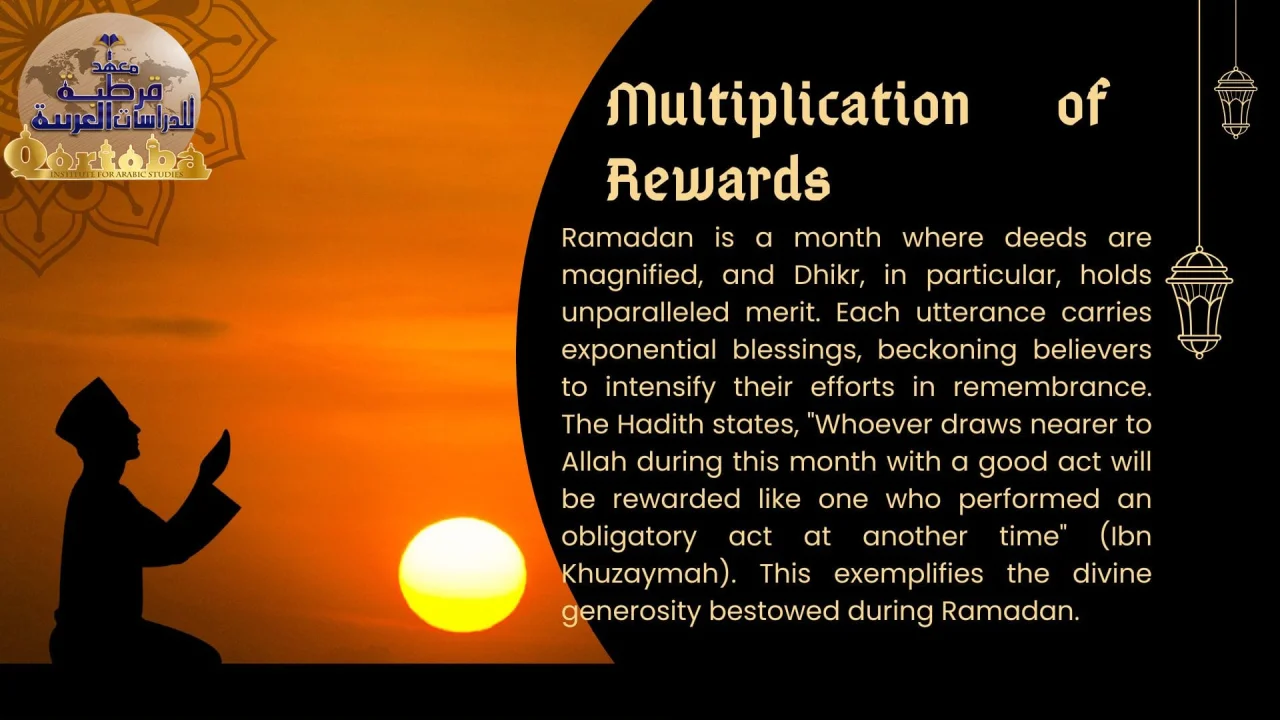
Ramadan is a month where deeds are magnified, and Dhikr, in particular, holds unparalleled merit. Each utterance carries exponential blessings, beckoning believers to intensify their efforts in remembrance. The Hadith states, "Whoever draws nearer to Allah during this month with a good act will be rewarded like one who performed an obligatory act at another time" (Ibn Khuzaymah). This exemplifies the divine generosity bestowed during Ramadan.
- The Night of Decree (Laylat al-Qadr)
Laylat al-Qadr, described as "better than a thousand months", offers a unique opportunity for Dhikr. Worship on this night is equivalent to a lifetime of devotion, an invitation to unparalleled spiritual enrichment.


- Overcome Dhikr challenges with Qortoba Institution
For non-native Muslim speakers, the practice of Dhikr can present linguistic and cultural challenges, particularly when the sacred Arabic phrases lack immediate familiarity. Qortoba Institution for Learning Arabic and the Qur'an addresses these obstacles through a multifaceted approach:
- Linguistic Empowerment
Qortoba Institution provides comprehensive Arabic language online courses tailored to non-native speakers, enabling them to engage with Dhikr authentically and meaningfully. Through Quranic Arabic online classes, Qortoba Institution empowers scholars to read Arabic, recite Qur'an and internalize Dhikr with confidence.
- Focused Ramadan Programs
Recognizing the unique spiritual opportunities of Ramadan, Qortoba Institution offers specialized programs for kids & adults that integrate Dhikr with Quranic studies and Tarawih preparation. These programs ensure that non-native speakers can fully immerse themselves in the sanctity of Ramadan. Furthermore, Qortoba Institution provides non-native Muslim speaker students with tailored materials, such as transliterated Dhikr guides and interactive recitation tools, bridging the linguistic gap while maintaining the sacredness of the practice.


In summation, Dhikr (the remembrance of Allah) is a luminous act of worship that nourishes the soul, strengthens faith, and brings divine rewards. Its profound tranquility, forgiveness, and spiritual proximity render it indispensable to the non-native Muslim speakers’ journey. During Ramadan, these rewards are magnified, presenting an unparalleled opportunity for reflection and devotion. For non-native Muslim speakers, Qortoba Institution for Learning Arabic and the Qur'an serves as an indispensable ally, guiding them through the intricacies of Dhikr and enabling them to embrace its full transformative potential. By uniting linguistic empowerment with spiritual enrichment, Qortoba Institution ensures that all Muslims, regardless of their linguistic background, can engage deeply in the remembrance of Allah, reaping the timeless rewards of devotion.
An Egyptian house of Arabic learning — teaching Arabic and the Qur'an to non-native speakers online, in Cairo and in Al-Madinah.