QIAS Study Where Arabic Breathes: Learn Arabic Breathe Fluency
QIAS Study Where Arabic Breathes: Learn Arabic Breathe Fluency
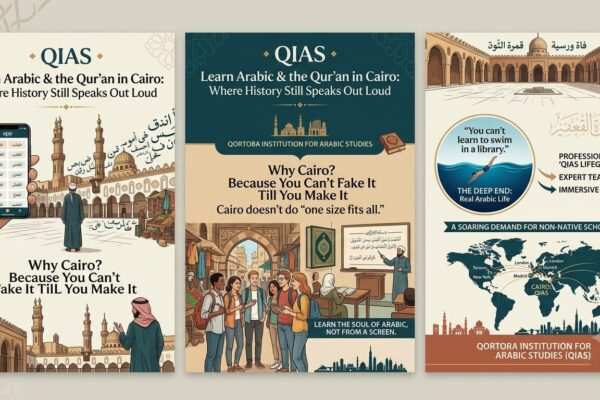
Fluency is not built from glossaries. It is built from listening to a muezzin at dawn, reading a manuscript, and bargaining for bread without switching to English. QIAS (Qortoba Institution for Arabic Studies) sits at that intersection — between Al-Azhar’s stone arcades and the lantern-lit lanes of Al-Hussein. QIAS designs in-person programs for non-native speakers learners worldwide such as Spain, Germany, Holland, Britain, America, France, and Canada who want academic depth and street-level command in one path. Since, Grammar here is taught beside the people who use it, and Qur’anic recitation is learned where it has been taught for a millennium.
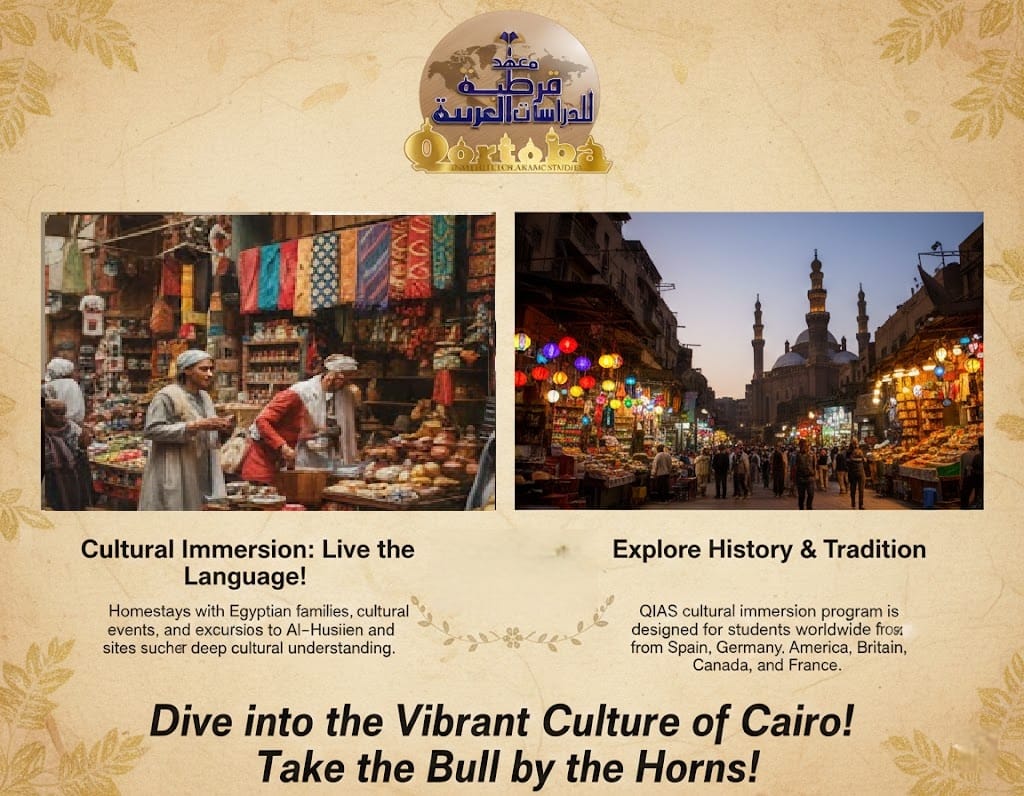

- Why QIAS Face to Face in Cairo?
Screens can introduce a word. Cairo teaches you its weight. Three advantages emerge only through physical presence.
- Pronunciation Tuned by Ear: Arabic’s emphatics — ṣād ص, ḍād ض, ṭāʾ ط, ẓāʾ ظ — reshape meaning instantly. In class, an instructor stops a student from blurring qalb قلب “heart” into kalb كلب “dog.” That immediate correction, impossible through a recording, is what fixes sound before it becomes habit.
- Context Learned Through Use: Qur’anic phrasing and Cairo conversation share roots but diverge in tone. Students notice when In shā’ Allāh إن شاء الله signals hope and when Bi’idhnillāh بإذن الله signals permission. Those shades are caught in a café, not a quiz.
- Peer Drive in Small Groups: Accountability is built in. A learner from Barcelona refines i‘rāb إعراب while a peer from Ottawa asks the next question. Progress accelerates because no one studies alone.
- Curriculum That Prioritizes Mastery Over
| COURSE | Main Objective | Defining Experience |
| MSA Fundamentals & Sound Training | Modern Standard Arabic + Qur’anic articulation | Field drills in Al-Hussein market alleys |
| Qur’anic Arabic & Thematic Study | Syntax, morphology, surah themes | Weekly ḥalaqah within Al-Azhar’s halls |
| Arabic for Journalism & Public Address | News style, khutbah, rhetorical devices | Devices Deconstructing live clips from BBC Arabic |
| Tajwīd → Ijāzah Progression | Precise recitation → Memorization → Sanad | Individual chain of transmission with licensed reciters |
Sample Session, MSA Fundamentals :
- Analyze al-iḍāfah الإضافة through verses of Sūrat Al-Raḥmān
- Micro-task on Al-Muizz — order ‘aṣīr qasab عصير قصب “sugarcane juice” and ask vendors ayyu aḥsan? أيّ أحسن؟ “Which is better?”
- Reflection: Qur’anic line فَبِأَيِّ آلَاءِ رَبِّكُمَا تُكَذِّبَانِ “So which of your Lord’s blessings will you deny?” [Al-Raḥmān 55:13]. Given, attention trains the tongue.
- Edutainment Rooted in QIAS
QIAS uses the word “edutainment” only when learning happens outside four walls.
- Visits to Al-Azhar: Non-native speakers scholars all over the world such as Spain, Germany, Holland, America, Britain, Canada, and France, sit for a short lesson delivered by an Azhari teacher, then outline his argument in class. This links medieval delivery to modern comprehension.
- Al-Hussein Dialogues:
Assignment: buy ful wa ṭa‘miyya فول وطعمية “beans and falafel” and ask locals Mā qissat…? ما قصة…؟ “What is the story of…?” Record, transcribe, and compare dialect patterns to (fusḥā) Standard & (Ammiya) Colloquial.
- Pressroom Workshop: Side-by-side register study.
Arabic: المملكة تعز التعاون الخليجي “The Kingdom reinforces Gulf cooperation”
English: “Riyadh bolsters Gulf ties”
Given, Arabic leans nominal and measured; English leans verbal and punchy. Students practice choosing the right register.
- Expressions Learned Through Daily Use
| Arabic | English | Natural Setting |
| Jazāk Allāhu khayran جزاك الله خيرًا | خيرًا“May Allah grant you good” | Thanking |
| Ma‘lish معلش | “It’s okay / No worries” | Everyday Cairo reassurance |
| Bi-ṣidq بصدق | “Honestly” | Opening a media commentary |
Students stop translating these and start using them as reflex.
- QIAS Instruction Calibrated for Non-Native Speakers Learners
Spanish speakers: draw on Latin cognates in kitāb كتاب.
German students: apply case logic to Arabic i‘rāb.
English speakers: map idioms — “to cut to the chase” becomes adkhul fī al-mawḍū‘ ادخل في الموضوع “enter the subject.”
French learners: move from nasal vowels to Arabic emphasis.
Small cohorts ensure a student from Vancouver is visible and a learner from Berlin gets feedback while the thought is fresh.
In a nut shell, learning Arabic & Quraan is carried forward for centuries. Since, Al-Azhar’s minaret has called students to knowledge. Today that call reaches Madrid, Munich, London, Holland, Chicago, Paris, and Montreal through QIAS (Qortoba Institution for Arabic Studies). Thus, QIAS stands where turāth تراث “inheritance” meets modern Arabic — in media, in business, in the daily cadence of Cairo. Learn Arabic Where It Is Spoken Proofed for grammar, punctuation, and rhythm. Arabic is shown with professional transliteration and translation. Therefore, with QIAS non-native speakers scholars across the globe can learn Arabic and breathe fluency.
Tag:arabic, Arabic alphabet, Arabic Grammar, Arabic language, Arabic languages . Arabic languages . arabic alphabet . arabic alphabet in english . arabic curriculum for kids ., Arabic languages . Arabic languages . arabic alphabet . arabic alphabet in english . arabic curriculum for kids . muslim learn arabic, learn Arabic languages . Arabic languages . arabic alphabet . arabic alphabet in english . arabic curriculum for kids ., world Arabic language day . française